

 GMA Brandtalk
 Tracking
 Archives


Teodoro: PH focusing on deterrence, not just US retaliation amid WPS tension
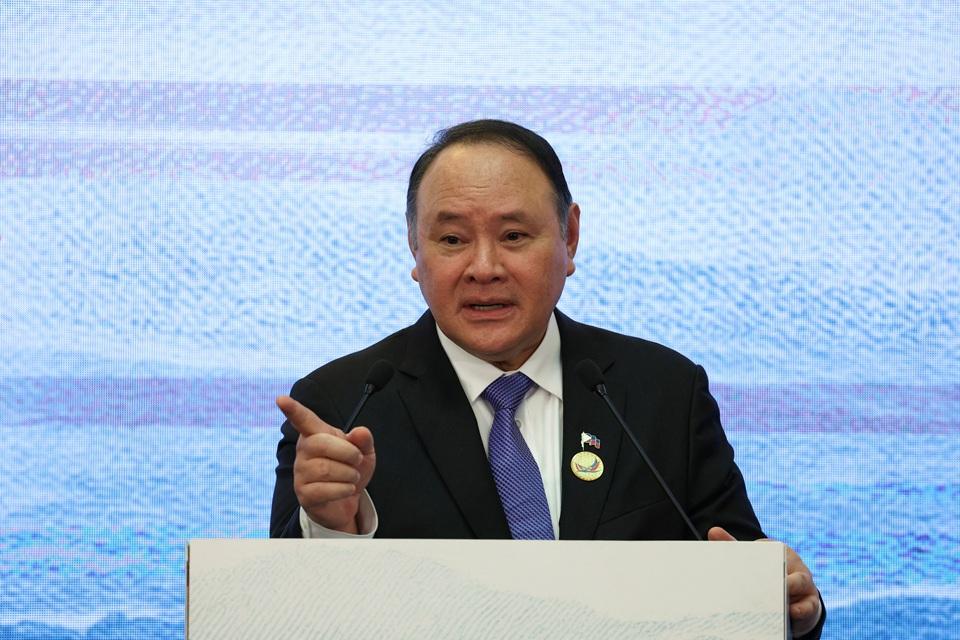
The Philippines is focusing on strengthening its defense capabilities to deter potential attacks rather than relying on the United States' commitment to retaliate amid the tension in the West Philippine Sea (WPS).
In a press conference, Defense Secretary Gilberto Teodoro Jr. said the Philippines was giving greater importance to building deterrence under the Mutual Defense Treaty (MDT) with the US.
"The MDT contains several provisions and normally the focus is on Article IV, which is the retaliation provision. You can be ironclad on IV, which is useless also because an attack has already occurred," Teodoro said.
"What we're working on is II and III. Meaning to say, to work with one another to build deterrence. And I think it is more important to be ironclad in deterrence than in retaliation," he added.
In the 1951 Treaty between Manila and Washington, Articles II, III, and IV establish how both nations build defense capacity, consult on threats, and respond to armed attacks in the Pacific.
Article II provides that both countries commit to maintaining and developing their individual and collective capacity to resist armed attacks, separately and jointly.
Article III states that foreign ministers or their deputies will consult whenever either country believes its territorial integrity, political independence, or security is threatened by an external armed attack in the Pacific.
Meanwhile, Article IV states that each party recognizes that an armed attack in the Pacific on either nation endangers its own peace and safety, and agrees to act to meet the common danger according to its constitutional processes.
Teodoro pointed out that retaliation could not reverse casualties or damage to society once an attack had already happened.
He said the country's deterrence posture was improving, citing the $2 billion assistance package announced by US President Donald Trump, which includes financing and grants for Philippine defense capabilities.
Teodoro said he hoped the Philippine government would also allocate funds to sustain the grants and develop capabilities through infrastructure.
He also stressed the need to address bureaucratic delays that hamper the country's defense modernization efforts.
He described the US commitment to strengthening Philippine defense capabilities as increasingly evident.
“They are putting, proverbially, their money where their mouth is,” Teodoro said. — BAP, GMA News

